


Page 98 - Abstract Book KONIKA 18
P. 98
Respiroloy

                                              O-RES-005
                    Long-term Symptoms in Adolescent After SARS-CoV-2 Infection:
                                      A Prospective Cohort Study

                                     Jessica Christina, Nico Adrian Rahardja
                             General Practitioner, UKRIDA Teaching Hospital, Jakarta, Indonesia

                                               Abstract
            Background Long Coronavirus disease 2019 (COVID-19) is a term used to describe prolonged symptoms
            that continue to occur several weeks to months following SARS-CoV-2 infection. Reports of long covid in
            children is at present very limited and have not been well characterized.  Objective To define the incidence and
            assess long-term symptoms of adolescents aged 10 to 18-year-old previously hospitalized with COVID-19.
            Methods A longitudinal prospective cohort study of adolescent (10 to 18-year-old) admitted with confirm
            COVID-19 was conducted at Ukrida Teaching Hospital between December 2020 and April 2021. Patient
            data and clinical characteristics were collected at the time of admission and an online follow up assessment
            via Google form were taken at 28  days and 3 months after patient negative RT-PCR COVID-19 test result.
                                    th
            Results A total of 43 (70.5%) adolescents completed the follow up assessment and were included in the
            study. Median age was 15.6 years and 25 (58.1%) were boys. Most participants, 39 (90.7%) were hospitalized
            with mild symptoms. Through online assessment at 28  days and 3 months post COVID-19 consecutively,
                                                   th
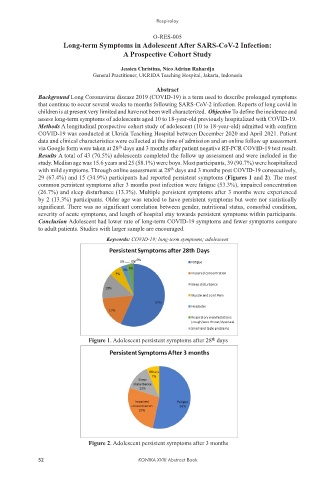
            29 (67.4%) and 15 (34.9%) participants had reported persistent symptoms (Figures 1 and 2). The most
            common persistent symptoms after 3 months post infection were fatigue (53.3%), impaired concentration
            (26.7%) and sleep disturbance (13.3%). Multiple persistent symptoms after 3 months were experienced
            by 2 (13.3%) participants. Older age was tended to have persistent symptoms but were nor statistically
            significant. There was no significant correlation between gender, nutritional status, comorbid condition,
            severity of acute symptoms, and length of hospital stay towards persistent symptoms within participants.
            Conclusion Adolescent had lower rate of long-term COVID-19 symptoms and fewer symptoms compare
            to adult patients. Studies with larger sample are encouraged.

                                 Keywords: COVID-19; long-term symptoms; adolescent


                           Figure 1. Adolescent persistent symptoms after 28  days
                                                                th


                           Figure 2. Adolescent persistent symptoms after 3 months

            52                            KONIKA XVIII Abstract Book

