


Page 50 - Abstract Book KONIKA 18
P. 50
Cardiology

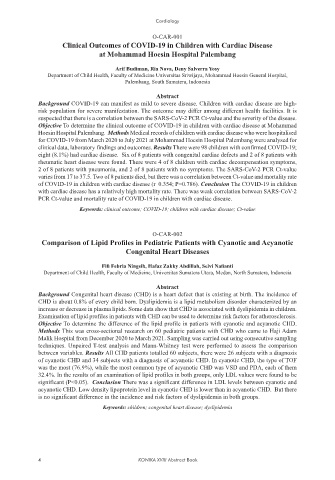
                                              O-CAR-001
                    Clinical Outcomes of COVID-19 in Children with Cardiac Disease
                              at Mohammad Hoesin Hospital Palembang

                                   Arif Budiman, Ria Nova, Deny Salverra Yosy
               Department of Child Health, Faculty of Medicine Universitas Sriwijaya, Mohammad Hoesin General Hospital,
                                      Palembang, South Sumatera, Indonesia

                                               Abstract
            Background COVID-19 can manifest as mild to severe disease. Children with cardiac disease are high-
            risk population for severe manifestation. The outcome may differ among different health facilities. It is
            suspected that there is a correlation between the SARS-CoV-2 PCR Ct-value and the severity of the disease.
            Objective To determine the clinical outcome of COVID-19 in children with cardiac disease at Mohammad
            Hoesin Hospital Palembang.  Methods Medical records of children with cardiac disease who were hospitalised
            for COVID-19 from March 2020 to July 2021 at Mohammad Hoesin Hospital Palembang were analysed for
            clinical data, laboratory findings and outcomes. Results There were 98 children with confirmed COVID-19;
            eight (8.1%) had cardiac disease.  Six of 8 patients with congenital cardiac defects and 2 of 8 patients with
            rheumatic heart disease were found. There were 4 of 8 children with cardiac decompensation symptoms,
            2 of 8 patients with pneumonia, and 2 of 8 patients with no symptoms. The SARS-CoV-2 PCR Ct-value
            varies from 17 to 37.5. Two of 8 patients died, but there was a correlation between Ct-value and mortality rate
            of COVID-19 in children with cardiac disease (r  0.354; P=0.786). Conclusion The COVID-19 in children
            with cardiac disease has a relatively high mortality rate. There was weak correlation between SARS-CoV-2
            PCR Ct-value and mortality rate of COVID-19 in children with cardiac disease.
                         Keywords: clinical outcome; COVID-19; children with cardiac disease; Ct-value


                                              O-CAR-002
             Comparison of Lipid Profiles in Pediatric Patients with Cyanotic and Acyanotic
                                      Congenital Heart Diseases

                               Fifi Febria Ningsih, Hafaz Zakky Abdillah, Selvi Nafianti
              Department of Child Health, Faculty of Medicine, Universitas Sumatera Utara, Medan, North Sumatera, Indonesia
                                               Abstract
            Background Congenital heart disease (CHD) is a heart defect that is existing at birth. The incidence of
            CHD is about 0.8% of every child born. Dyslipidemia is a lipid metabolism disorder characterized by an
            increase or decrease in plasma lipids. Some data show that CHD is associated with dyslipidemia in children.
            Examination of lipid profiles in patients with CHD can be used to determine risk factors for atherosclerosis.
            Objective To determine the difference of the lipid profile in patients with cyanotic and acyanotic CHD.
            Methods This was cross-sectional research on 60 pediatric patients with CHD who came to Haji Adam
            Malik Hospital from December 2020 to March 2021. Sampling was carried out using consecutive sampling
            techniques. Unpaired T-test analysis and Mann-Whitney test were performed to assess the comparison
            between variables. Results All CHD patients totalled 60 subjects, there were 26 subjects with a diagnosis
            of cyanotic CHD and 34 subjects with a diagnosis of acyanotic CHD. In cyanotic CHD, the type of TOF
            was the most (76.9%), while the most common type of acyanotic CHD was VSD and PDA, each of them
            32.4%. In the results of an examination of lipid profiles in both groups, only LDL values were found to be
            significant (P<0.05).  Conclusion There was a significant difference in LDL levels between cyanotic and
            acyanotic CHD. Low density lipoprotein level in cyanotic CHD is lower than in acyanotic CHD.  But there
            is no significant difference in the incidence and risk factors of dyslipidemia in both groups.
                               Keywords: children; congenital heart disease; dyslipidemia


            4                             KONIKA XVIII Abstract Book

