


Page 311 - Abstract Book KONIKA 18
P. 311
Neonatology

                                              P-NEO-047
                           A Case Report of Thanatophoric Dysplasia Type 1
                         with a P.Ser371Cys Variant in FGFR3 Gene Mutation

                          Ariantana M.I., Sjahid S.I, Fitrya I. N., Darm.awijaya A., Nuswantara S.
                             Santosa Hospital Bandung Central, Bandung, West Java, Indonesia

                                               Abstract
            Background Thanatophoric dysplasia (TD) is congenital, sporadic, and the most lethal skeletal dysplasia
            caused by new mutation in Fibroblast Growth Factor Receptor (FGFR) 3 gene. TD’s common features
            are micromelia, lungs’ hypoplasia, and macrocephaly. Diagnosis of TD is usually based on prenatal
            ultrasound, physical examination, and radiologic studies without being confirmed by DNA analysis.
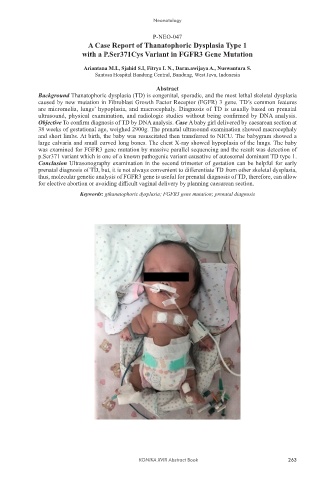
            Objective To confirm diagnosis of TD by DNA analysis. Case A baby girl delivered by caesarean section at
            38 weeks of gestational age, weighed 2900g. The prenatal ultrasound examination showed macrocephaly
            and short limbs. At birth, the baby was resuscitated then transferred to NICU. The babygram showed a
            large calvaria and small curved long bones. The chest X-ray showed hypoplasia of the lungs. The baby
            was examined for FGFR3 gene mutation by massive parallel sequencing and the result was detection of
            p.Ser371 variant which is one of a known pathogenic variant causative of autosomal dominant TD type 1.
            Conclusion Ultrasonography examination in the second trimester of gestation can be helpful for early
            prenatal diagnosis of TD, but, it is not always convenient to differentiate TD from other skeletal dysplasia,
            thus, molecular genetic analysis of FGFR3 gene is useful for prenatal diagnosis of TD, therefore, can allow
            for elective abortion or avoiding difficult vaginal delivery by planning caesarean section.
                         Keywords: gthanatophoric dysplasia; FGFR3 gene mutation; prenatal diagnosis


                                           KONIKA XVIII Abstract Book                                                                     263

