


Page 304 - Abstract Book KONIKA 18
P. 304
Neonatology

                                              P-NEO-034
                  A Preterm Baby with Hyaline Membrane Disease, Perinatal Infection,
                             and Ladd’s Band Malrotation: A Case Report

                       Tasya Gitaputri Pranoto, Nancy Napitupulu, Eric Gultom,  Naomi E. F. Dewanto
                           Department of NICU, Siloam Hospitals Kebon Jeruk, Jakarta, Indonesia

                                               Abstract
            Background Malrotation can be symptomatic or not occur between 1/200 and 1/500 live births. Approximately
            50 to 70% of cases are diagnosed during the neonatal period. Objective To report is to familiarize with
            variations in the presentation of malrotation to optimize outcome in many cases. Case A baby girl weighing
            1554 g was born 32 weeks from a 26-year-old mother via sectio caesarean due to pre-eclampsia and
            oligohydramnios. Four hours after birth the baby was put on CPAP due respiratory distress. Meconium and
            urine was noted from the first day. At 2 days of age, abdominal distension, orogastric tube (OGT) production
            was 12 mL dark green brownish, weakened peristaltic movement was found. Procalcitonin (PCT) level was
            0.57 ng/mL. The baby fasted, blood culture was taken, antibiotics were given. At the 4 days of age, PCT level
            decreased to 0.14 ng/mL, blood culture was sterile but abdomen was still distended, OGT production was
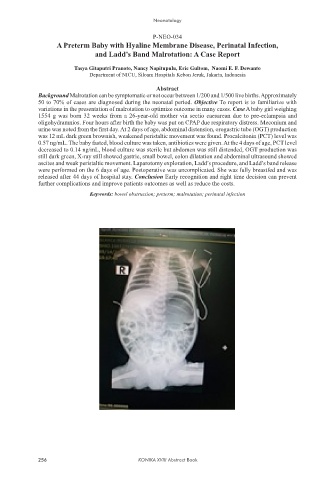
            still dark green, X-ray still showed gastric, small bowel, colon dilatation and abdominal ultrasound showed
            ascites and weak peristaltic movement. Laparotomy exploration, Ladd’s procedure, and Ladd’s band release
            were performed on the 6 days of age. Postoperative was uncomplicated. She was fully breastfed and was
            released after 44 days of hospital stay. Conclusion Early recognition and right time decision can prevent
            further complications and improve patients outcomes as well as reduce the costs.
                            Keywords: bowel obstruction; preterm; malrotation; perinatal infection


            256                           KONIKA XVIII Abstract Book

