


Page 289 - Abstract Book KONIKA 18
P. 289
Neonatology

                                               P-NEO-008
                       Severe Hyperbilirubinemia: Is It Hereditary Spherocytosis?

                               Charity Monica, Brigitta I. R.V. Corebima, Eko Sulistijono
                  Department of Child Heatlh, Faculty of Medicine, Universitas Brawijaya Malang, East Java, Indonesia

                                               Abstract
            Background Hereditary spherocytosis is an autosomal dominant inherited disorder which causes severe
            hyperbilirubinemia in neonates. It occurs in 1 in 2000 individuals of Northern European descent. This
            disease is less common in other ethnicities. There is no definite data about the prevalence in Indonesia.
            Objective To make diagnostic approach of hereditary spherocytosis in neonates with severe hyperbilirubinemia.
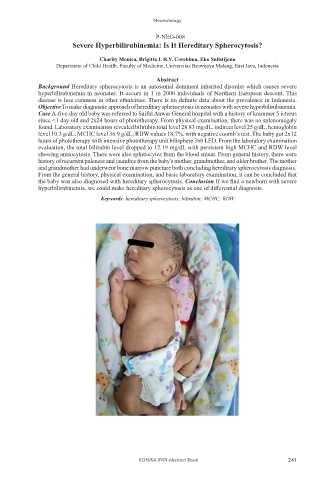
            Case A-five-day old baby was referred to Saiful Anwar General hospital with a history of krammer 5 icterus
            since <1 day old and 2x24 hours of phototherapy. From physical examination, there was no splenomegaly
            found. Laboratory examination revealed bilirubin total level 28.83 mg/dL, indirect level 25 g/dL, hemoglobin
            level 10.3 g/dL, MCHC level 36.9 g/dL, RDW values 18,7%, with negative coomb’s test. The baby got 2x12
            hours of phototherapy with intensive phototherapy unit bilisphere 360 LED. From the laboratory examination
            evaluation, the total bilirubin level dropped to 12.19 mg/dL with persistent high MCHC and RDW level
            showing anisocytosis. There were also spherocytes from the blood smear. From general history, there were
            history of recurrent paleness and jaundice from the baby's mother, grandmother, and older brother. The mother
            and grandmother had underwent bone marrow puncture both concluding hereditary spherocytosis diagnosis.
            From the general history, physical examination, and basic laboratory examination, it can be concluded that
            the baby was also diagnosed with hereditary spherocytosis. Conclusion If we find a newborn with severe
            hyperbilirubinemia, we could make hereditary spherocytosis as one of differential diagnosis.
                               Keywords: hereditary spherocytosis; bilirubin; MCHC; RDW


                                           KONIKA XVIII Abstract Book                                                                     241

