


Page 254 - Abstract Book KONIKA 18
P. 254
Infection & Tropical Disease

                                               P-ITD-003
                        Intestinal Obstruction Caused by Ascaris Lumbricoides:
                       A Case Report from an Endemic Area in North Kalimantan

                            Lili Widianto, Sayyidah Auliany, Dwi Sapriyantina, Dian Artanti
                   Department of Child Health, North Kalimantan General Hospital, Tarakan, North Borneo, Indoesia

                                               Abstract
            Background The international community has pledged through the Sustainable Development Goals (SDGs)
            to eliminate ascariasis as one of neglected tropical diseases. Ascariasis caused by Ascaris lumbricoides
            infestation in human. When symptoms do occur, they relate to the larval life cycle. Heavy worm burden (>60)
            can lead to Intestinal obstruction. Objective To demonstrate successful conservative management on intestinal
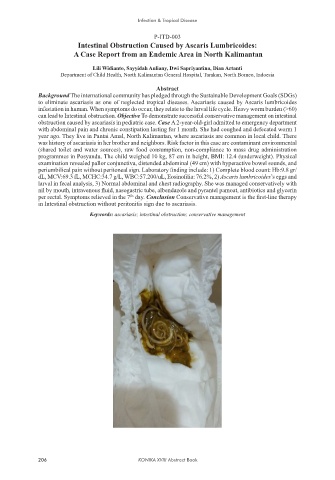
            obstruction caused by ascariasis in pediatric case. Case A 2-year-old-girl admitted to emergency department
            with abdominal pain and chronic constipation lasting for 1 month. She had coughed and defecated worm 1
            year ago. They live in Pantai Amal, North Kalimantan, where ascariasis are common in local child. There
            was history of ascariasis in her brother and neighbors. Risk factor in this case are contaminant environmental
            (shared toilet and water sources), raw food consumption, non-compliance to mass drug administration
            programmes in Posyandu. The child weighed 10 kg, 87 cm in height, BMI: 12.4 (underweight). Physical
            examination revealed pallor conjunctiva, distended abdominal (49 cm) with hyperactive bowel sounds, and
            periumbilical pain without peritoneal sign. Laboratory finding include: 1) Complete blood count: Hb:9.8 gr/
            dL, MCV:69.3 fL, MCHC:34.7 g/L, WBC:57.200/uL, Eosinofilia: 76.2%, 2) Ascaris lumbricoides’s eggs and
            larval in fecal analysis, 3) Normal abdominal and chest radiography. She was managed conservatively with
            nil by mouth, intravenous fluid, nasogastric tube, albendazole and pyrantel pamoat, antibiotics and glycerin
            per rectal. Symptoms relieved in the 7  day. Conclusion Conservative management is the first-line therapy
                                        th
            in Intestinal obstruction without peritonitis sign due to ascariasis.
                            Keywords: ascariasis; intestinal obstruction; conservative management


            206                           KONIKA XVIII Abstract Book

