


Page 163 - Abstract Book KONIKA 18
P. 163
Emergency & Pediatric Intensive Care

                                              P-EPIC-007
                         Effectiveness of Simple Pediatric Rapid Response Team
                       at Covid-19 Emergency Hospital Kemayoran (RSDCWAK)

                      Fitria Mahrunnisa, Tiona Romauli, Natasha Anjasmara, Safitri Nenik, Nia Fitriyani
                                     Covid-19 Emergency Hospital Kemayoran

                                               Abstract
            Background Consist of 4 buildings with total 7800 beds capacity, RSDCWAK were run by only 2 to 4
            physicians for each building. Pediatric emergency condition related to Covid-19 might happen suddenly and
            need early recognition. On limited resources, simple Pediatric Rapid Response Team (PRRT) may help for
            early recognition of emergency condition and avoid deterioration for better outcome. Objective To identify
            effectiveness of simple PRRT activation in COVID-19 Emergency Hospital Kemayoran (RSDCWAK),
            Jakarta. Methods A descriptive-observational study from PRRT activation report in RSDCWAK during
            December 2020 to August 2021. Results Simple, 1-tier system PRRT in RSDCWAK consist of pediatrician,
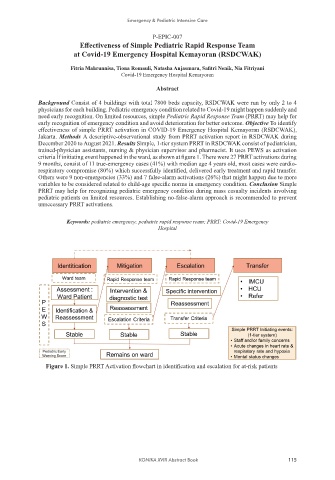
            trained-physician assistants, nursing & physician supervisor and pharmacist. It uses PEWS as activation
            criteria If initiating event happened in the ward, as shown at figure 1. There were 27 PRRT activations during
            9 months, consist of 11 true-emergency cases (41%) with median age 4 years old, most cases were cardio-
            respiratory compromise (80%) which successfully identified, delivered early treatment and rapid transfer.
            Others were 9 non-emergencies (33%) and 7 false-alarm activations (26%) that might happen due to more
            variables to be considered related to child-age specific norms in emergency condition. Conclusion Simple
            PRRT may help for recognizing pediatric emergency condition during mass casualty incidents involving
            pediatric patients on limited resources. Establishing no-false-alarm approach is recommended to prevent
            unnecessary PRRT activations.

                     Keywords: pediatric emergency; pediatric rapid response ream; PRRT; Covid-19 Emergency
                                                Hospital


               Figure 1. Simple PRRT Activation flowchart in identification and escalation for at-risk patients


                                           KONIKA XVIII Abstract Book                                                                     115

