


Page 197 - Abstract Book KONIKA 18
P. 197
Endocrinology

                                              P-ENDO-041
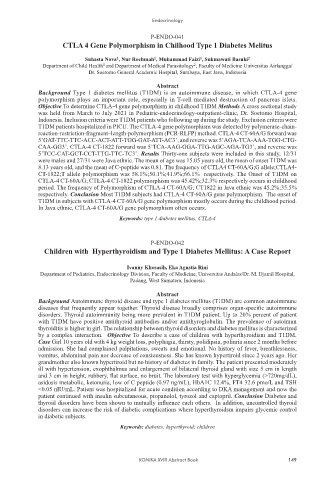
                    CTLA 4 Gene Polymorphism in Chilhood Type 1 Diabetes Melitus

                                               1
                                    1
                          Suhasta Nova , Nur Rochmah , Muhammad Faizi , Sukmawati Basuki 2
                                                            1
                                1
                                                          2
              Department of Child Health and Department of Medical Parasitology , Faculty of Medicine Universitas Airlangga/
                           Dr. Soetomo General Academic Hospital, Surabaya, East Java, Indonesia

                                               Abstract
            Background Type 1 diabetes mellitus (T1DM) is an autoimmune disease, in which CTLA-4 gene
            polymorphism plays an important role, especially in T-cell mediated destruction of pancreas islets.
            Objective To determine CTLA-4 gene polymorphism in childhood T1DM Methods A cross sectional study
            was held from March to July 2021 in Pediatric-endocrinology-outpatient-clinic, Dr. Soetomo Hospital,
            Indonesia. Inclusion criteria were T1DM patients who following up during the study. Exclusion criteria were
            T1DM patients hospitalized in PICU. The CTLA-4 gene polymorphism was detected by polymerase-chain-
            reaction-restriction-fragment–length-polymorphism (PCR-RLFP) method. CTLA-4 CT-60A/G forward was
            5’GAT-TTC-TTC-ACC-ACT-ATT-TGG-GAT-ATT-AC3’, and reverse was 5’AGA-TCA-AAA-TGG-CTG-
            CAA-GG3’. CTLA-4 CT-1822 forward was 5’TCA-AAG-GGA-TTG-AGC-AGA-TG3’, and reverse was
            5’TCC-CAT-GCT-CCT-TTG-TTC-TC3’. Results Thirty-one subjects were included in this study, 12/31
            were males and 27/31 were Java ethnic. The mean of age was 15.05 years old, the mean of onset T1DM was
            8.13 years old, and the mean of C-peptide was 0.81. The frequency of CTLA4 CT-60A/G;G allele;CTLA4-
            CT-1822;T allele polymorphism was 58.1%;50.1%;41.9%;66.1%  respectively. The Onset of T1DM on
            CTLA-4 CT-60A/G; CTLA-4 CT-1822 polymorphism was 45.42%;32.3% respectively occurs in childhood
            period. The frequency of Polymorphism of CTLA-4 CT-60A/G; CT1822 in Java ethnic was 45.2%;35.5%
            respectively. Conclusion Most T1DM subjects had CTLA-4 CT-60A/G gene polymorphism.  The onset of
            T1DM in subjects with CTLA-4 CT-60A/G gene polymorphism mostly occurs during the childhood period.
            In Java ethnic, CTLA-4 CT-60A/G gene polymorphism often occurs.
                                    Keywords: type 1 diabetes mellitus; CTLA-4


                                              P-ENDO-042
              Children with  Hyperthyroidism and Type 1 Diabetes Mellitus: A Case Report


                                       Ivanny Khosasih, Eka Agustia Rini
             Department of Pediatrics, Endocrinology Division, Faculty of Medicine, Universitas Andalas/Dr. M. Djamil Hospital,
                                        Padang, West Sumatera, Indonesia

                                               Abstract
            Background Autoimmune thyroid disease and type 1 diabetes mellitus (T1DM) are common autoimmune
            diseases that frequently appear together. Thyroid disease broadly comprises organ-specific autoimmune
            disorders. Thyroid autoimmunity being more prevalent in T1DM patient. Up to 20% percent of patient
            with T1DM have positive antithyroid antibodies and/or antithyroglobulin. The prevalence of autoimun
            thyroiditis is higher in girl. The relationship between thyroid disorders and diabetes mellitus is characterized
            by a complex interaction.  Objective To describe a case of children with hyperthyroidism and T1DM.
            Case Girl 10 years old with 4 kg weight loss, polyphagia, thirsty, polidipsia, poliuria since 2 months before
            admission. She had complained palpitations, sweats and emotional. No history of fever, breathlessness,
            vomitus, abdominal pain nor decrease of consiousness. She has known hypertiroid since 2 years ago. Her
            grandmother also known hypertiroid but no history of diabetes in family. The patient presented moderately
            ill with hypertension, exophthalmus and enlargement of bilateral thyroid gland with size 5 cm in length
            and 3 cm in height, rubbery, flat surface, no bruit. The laboratory test with hyperglycemia (>720mg/dL),
            asidosis metabolic, ketonuria, low of C peptide (0.97 ng/mL), HbA1C 12.4%, FT4 32.6 pmo/L and TSH
            <0.05 nIU/mL. Patient was hospitalized for acute condition according to DKA management and now the
            patient continued with insulin subcutaneous, propanolol, tyrozol and captopril. Conclusion Diabetes and
            thyroid disorders have been shown to mutually influence each others.  In addition, uncontrolled thyroid
            disorders can increase the risk of diabetic complications where hyperthyroidsm impairs glycemic control
            in diabetic subjects.
                                     Keywords: diabetes; hyperthyroid; children


                                           KONIKA XVIII Abstract Book                                                                     149

