


Page 191 - Abstract Book KONIKA 18
P. 191
Endocrinology

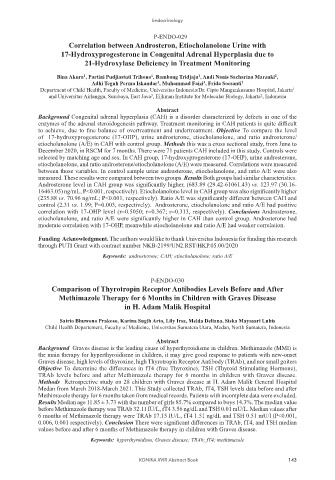
                                               P-ENDO-029
                     Correlation between Androsteron, Etiocholanolone Urine with
                   17-Hydroxyprogesterone in Congenital Adrenal Hyperplasia due to
                          21-Hydroxylase Deficiency in Treatment Monitoring

                  Bina Akura , Partini Pudjiastuti Trihono , Bambang Tridjaja , Andi Nanis Sacharina Marzuki ,
                                              1
                                                                                  2
                                                            1
                          1
                                                             3
                                                1
                            Adhi Teguh Perma Iskandar , Muhammad Faizi , Frida Soesanti 1
             Department of Child Health, Faculty of Medicine, Universitas Indonesia/Dr. Cipto Mangunkusumo Hospital, Jakarta 1
                                              3
               and Universitas Airlangga, Surabaya, East Java , Eijkman Institute for Molecular Biology, Jakarta , Indonesia
                                                                              2
                                               Abstract
            Background Congenital adrenal hyperplasia (CAH) is a disorder characterized by defects in one of the
            enzymes of the adrenal steroidogenesis pathway. Treatment monitoring in CAH patients is quite difficult
            to achieve, due to fine balance of overtreatment and undertreatment. Objective To compare the level
            of  17-hydroxyprogesterone (17-OHP), urine androsterone, etiocholanolone, and ratio androsterone/
            etiocholanolone (A/E) in CAH with control group. Methods this was a cross sectional study, from June to
            December 2020, in RSCM for 7 months. There were 71 patients CAH included in this study. Controls were
            selected by matching age and sex. In CAH group, 17-hydroxyprogesterone (17-OHP), urine androsterone,
            etiocholanolone, and ratio androsterone/etiocholanolone (A/E) were measured. Correlations were measured
            between those variables. In control sample urine androsterone, etiocholanolone, and ratio A/E were also
            measured. These results were compared between two groups. Results Both groups had similar characteristics.
            Androsterone level in CAH group was significantly higher, (683.89 (29.42-61061.43) vs. 123.97 (30.16-
            16463.05) ng/mL, P<0.001, respectively). Etiocholanolone level in CAH group was also significantly higher
            (235.88 vs. 70.96 ng/mL; P<0.001, respectively). Ratio A/E was significantly different between CAH and
            control (2.31 vs. 1.99; P=0.003, respectively).  Androsterone, etiocholanolone and ratio A/E had positive
            correlation with 17-OHP level (r=0.5050; r=0.367; r=0.313, respectively). Conclusions Androsterone,
            etiocholanolone, and ratio A/E were significantly higher in CAH than control group. Androsterone had
            moderate correlation with 17-OHP, meanwhile etiocholanolone and ratio A/E had weaker correlation.
            Funding  Acknowledgment. The authors would like to thank Universitas Indonesia for funding this research
            through PUTI Grant with contract number NKB-2199/UN2.RST/HKP.05.00/2020
                               Keywords:  androsterone; CAH; etiocholanolone; ratio A/E


                                              P-ENDO-030
                Comparison of Thyrotropin Receptor Antibodies Levels Before and After
                  Methimazole Therapy for 6 Months in Children with Graves Disease
                                      in H. Adam Malik Hospital
                   Satrio Bhuwono Prakoso, Karina Sugih Arto, Lily Irsa, Melda Deliana, Siska Mayasari Lubis
              Child Health Departement, Faculty of Medicine, Universitas Sumatera Utara, Medan, North Sumatera, Indonesia
                                               Abstract
            Background  Graves disease is the leading cause of hyperthyroidisme in children. Methimazole (MMI) is
            the main therapy for hyperthyroidisme in children, it may give good response to patients with new-onset
            Graves disease, high levels of thyroxine, high Thyrotropin Receptor Antibody (TRAb), and nor small goiters
            Objective To determine the differences in fT4 (free Thyroxine), TSH (Thyroid Stimulating Hormone),
            TRAb levels before and after Methimazole therapy for 6 months in children with Graves disease.
            Methods  Retrospective study on 28 children with Graves disease at H. Adam Malik General Hospital
            Medan from March 2018-March 2021. This Study collected TRAb, fT4, TSH levels data before and after
            Methimazole therapy for 6 months taken from medical records. Patients with incomplete data were excluded.
            Results Median age 11.85 ± 3.73 with the number of girls 85.7% compared to boys 14.3%. The median value
            before Methimazole therapy was TRAb 32.11 IU/L, fT4 3.56 ng/dL and TSH 0.01 mU/L. Median values after
            6 months of Methimazole therapy were TRAb 17.15 IU/L, fT4 1.51 ng/dL and TSH 0.51 mU/l (P<0.001,
            0.006, 0.001 respectively). Conclusion There were significant differences in TRAb, fT4, and TSH median
            values before and after 6 months of Methimazole therapy in children with Graves disease.
                            Keywords:  hyperthyroidism; Graves disease; TRAb; fT4; methimazole


                                           KONIKA XVIII Abstract Book                                                                     143

